Saturday, November 7, 2009

#55 - Documentary movies get cool.


It was the decade when...

People realized that the Documentary was more than an "hour-three" Oscar category.


Documentary filmmakers are a resilient bunch. Despite the dearth of money, the lack of public attention, the difficultly finding distribution - they have pressed on, rolling their Sisyphean boulder up the hill, hoping to, if they are lucky, get a brief moment in the sun at the Academy Awards, Holocaust topics being a good bet to achieve Oscar glory.

In the AUGHTS this long suffering genre had a kind of popular revolution. Instigated by the work of one uniquely popular documentarian, many filmmakers suddenly found their documentary movies acquiring not only critical praise but that most illusive of commodities: box office success. Best of all, there was nary a swastika in sight. Here are some of the highlights:

Bowling For Columbine (2002): Whatever your feelings on his politics or directorial style, all parties can agree that Michael Moore is the most financially successful documentary filmmaker of all time and probably the most widely seen. No other documentarian gets as broad an audience or a seat on Dave Letterman's couch to promote his films. For many people Moore is documentary cinema. His first film of this decade was one of his best and earned the orotund director his first Oscar. Grossing over 20 Million dollars domestically, Bowling For Columbine was nothing short of a blockbuster by the standards of the genre. Less an exegesis on the Columbine massacre than a free-form essay analyzing the violence at the heart of the American experience, Columbine is Moore at his least didactic. The party-line invectives for which he is famous are less present here, preferring contemplative associations to lefty bromides. Without his firebrand opining however, the film becomes a double edged sword; it packs a wallop and yet remains slightly vacuous, the subject matter offering no neat resolutions or demagogues to denounce. No summation exists to tie together Moore's various analyses. There is, in the end, only the horrific absurdity of Columbine.

The Fog Of War (2003): For years Errol Morris has been something of a documentarians documentarian. Serious and solemn, Morris' films are highly focused and charged with epistemological purpose. The Fog of War has all the familiar Morrisian tropes: the menacing Phillip Glass score, the dreamy symbolic imagery, the moral seriousness. In the film, former Defense Secretary Robert McNamara sits before a stark white background (it looks like he is in an Apple Commercial) answering Morris' questions in a tone that feels like a cross between courtroom testimony and therapy couch confessional. Never going in for the kill, Morris allows his subject neither absolution nor damnation for his actions preferring instead to stress the many ambiguities that politics and war trade in. Perhaps such fence-sitting is a kind of cop-out but it makes for exciting, thought-provoking cinema in a way that crude indictment would not. The film won Morris his first Oscar.

Capturing the Friedmans (2003): An unrelentingly horrible story of a middle-class suburban family eaten up alive by its patriarchs pedophilia, Friedmans uses as its through line the found footage of the family home movies, a near unwatchable record of dysfunction and familial collapse. The story plays out as a mystery of sorts: did the kindly father, a school teacher, really molest children in the basement of his suburban home? Did his son participate in the abuse? As the accusations against the family mount to more and more preposterous heights, the smell of hysteria overtakes reality. But, it's the stress from within that consumes, the family as crucible of anger, denial and confusion. The film lost the Oscar to The Fog of War but still earned a respectable three million dollars at the box office.

Fahrenheit: 9/11 (2004): The Titanic of documentaries (the Movie, not the ship), Fahrenheit: 9/11 was a phenomena. If the the Palme D'or at Cannes was more of a political rebuke to the Bush Administration than an award for excellence in filmmaking, it nonetheless was tangible proof that Moore's two hour invective was going to play a role in the national conversation as no documentary had before. Grossing over $200 Million in worldwide box office, the film acted as both battle cry and pat on the back for liberals everywhere. Too bad then that the movie actually adds up to little, despite the filmmaker's effectively conspiratorial tone. More a manipulation than a reasoned argument, Fahrenheit was concerned primarily with demonizing the President and his administration. An effective piece of propaganda, the movie did not succeed in it's real goal; George Bush was reelected in 2004 despite Moore's marching orders.

Super-Size Me (2004): A gimmick of a film, Super Size Me was the shockingly popular movie about a guy who eats nothing but McDonalds for a month. He gets fat and ill. Who knew? It garnered its creator Morgan Spurlock $11 Million dollars and a television contract.

Grizzly Man (2005): The voice of God in movies is usually pretty consistent: loud, masculine, and authoritative. I find this most depressing. I like to think that God sounds more like, well, like Werner Herzog: thoughtful, ironic, detached, wryly humorous and vaguely Continental. A voice which offers gentle but unsparing insight into the absurd activities happening down on planet earth. No commands or eternal judgments, just contemplative musings and poetic notions about existence. Well, I doubt God is very much like this (or like anything at all), but in Grizzly Man, Herzog's brilliant 2005 documentary about the life and death of Grizzly Bear enthusiast Tim Treadwell, I can at least pretend. Using mostly "found footage" taken by the ill-fated protagonist, Grizzly Man worked on many levels: It's the story of our relationship to the natural world and it's creatures. It's a cautionary tale of broken dreams and the pain of experiencing failure in a society that both practically guarantees it and yet has little patience for mediocrity. It's a tale about using and making cinema to escape our lives. Treadwell was not a scientist or trained naturalist, he was an out of work actor and LA beach bum who, fed up with Hollywood, people, and society, decided to leave it all behind with an act that both conceded his failure and was a last ditch effort to avoid it: he goes to live amongst the Grizzlies, recording his new life on video tape. His strange new lifestyle finally got him some long-sought media attention, including a now macabre visit to the Late Show with Dave Letterman. Herzog selectively chooses from Treadwell's copious footage to paint a picture of man at odds with civilization but doomed by his rejection of it. Throughout, Herzog interjects his modest and dispassionate musings, all the while concealing a bleak humor that permeates the whole movie. It's fascinating.

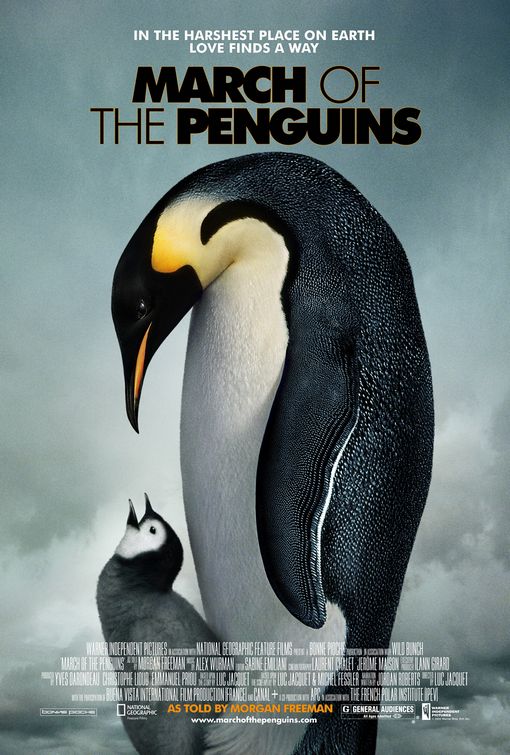
March of The Penguins (2005): Anthropomorphic children's folderol. Somewhere David Attenborough is wincing. It was also a blockbuster and Oscar winner.

An Inconvenient Truth (2006): Al Gore has been giving a PowerPoint slide show on Global Warming for years. In 2005, someone recorded it. Alarmist and shocking, the subject matter mattered more than the filmmaking. It won the former VP an Oscar (and probably a Nobel too).

Man on Wire (2008): Though a certain 2001 event goes blissfully unmentioned in this documentary about performance artist Philipe Petit's 1974 illegal tight-rope walk between the two towers of the World Trade Center, the film acts as a sort of elegiac tribute nonetheless. While Petit's act would be a fascinating story in any context, it's the resonance of what happened later that gives the film it's real purchase. Man on Wire allows us to see the Towers as something more than flaming infernos. The film is an Oscar-winning celebration of measured mischievousness and risk-taking, literalizing the metaphor that life itself is a tight-rope walk, and thank God for that.


Friday, November 6, 2009

#56 - Martha Stewart Goes to Jail


It was the decade when...

Inmate No. 55170-054 brought some class to the Alderson Federal Women's Prison.


$45,673 smakaroonies. That's the dollar figure that Martha Stewart saved when she illegally sold her IMClone stock the day before its share price tanked. Quick refresher: Martha Stewart is a billionaire. A model business woman sitting atop a Golden Horde of her own making called Martha Stewart Living Omnimedia ("Living Omnimedia" sounding less like a corporation than a Sci-fi monster with a murky ontological status), a $45,000 loss is about as consequential to her financial solvency as is the 2 bucks I spend buying my coffee at the corner bodega. Less.

But sell she did. And so began a string of events that would find as its denouement the absurd reality of Martha Stewart - domestic diva and style guru to millions, the epitome of taste, elegance and poise - serving six months in the clinker alongside women for whom a mullet is anything but a seafood dinner. Of course, Martha maintained her innocence, and why not? A businessperson, especially a woman, doesn't get to the top of a major corporation and accumulate a billion dollars by playing sweet and nice with the boardroom sharks and wall street vipers. They get there by standing toe to toe, sinking to the same lows, bottom-feeding all the way to the top. Capitalism is blood sport. Martha merely had wherewithal to hide her claws in well-tailored gloves. Was the sale illegal? The thought probably never crossed her mind. Not after the shit that she has undoubtedly pulled in the past, and most of that stuff was probably legal.

While behind every great fortune there may be a great crime, this was not it. This...this highly selective and conspicuously high-profile use of government resources, this...was a trophy prosecution. Martha Stewart was the sort of attention grabbing white collar criminal that beleaguered DA's with delusions of grandeur (and future political ambitions) salivate over. Martha's highly cultivated perfectionist image and runaway success had already generated enough resentment among the general populace that the idea of bringing down this sacred cow made many hungry for some Tartare. For the wine pairing I recommend the '04 Schadenfreude. When being pressed about the stock trade on Good Morning America during a routine cooking segment we all got to watch the worm wriggle on the hook; "I just want to focus on my salad." said Martha, proving that even ice queens can sweat.

But when the not-so-blind scales of justice eventually tilted against Ms. Stewart she found herself in the surreal position of having to leave her post as one of the most powerful women in business to make license plates with West Virginian riff-raff. A backlash to all the negative press gained speed and a new cry was heard: FREE MARTHA! After months of being put through the wringer, Martha was finally getting laid out to dry. Maybe people were starting to pity the fallen goddess or maybe they felt that justice, if not miscarried, had been at least C-sectioned or perhaps they were just grateful for the Halloween costume idea, but, whatever the cause, sentiment shifted in Martha's favor. M Diddy, as was her cell-block sobriquet, had now begun to follow the yellow brick road all the way to the other Emerald City of American narrative: If she already had trafficked in "The Fall From Grace" now it was sequel time with "The Redemptive Comeback." Omnimedia stock - which had, as you could imagine, suffered though some lean times in the early Aughts - doubled in value while it's founder was in prison. Martha even started a fashion craze for Ponchos on the day she was finally released (see this AUGHT post for full Poncho analysis). Within months Stewart was back on TV with her own new daytime talk show. Martha's downfall did something special for the somewhat chilly icon, it humanized here like no PR campaign ever could.

In retrospect, Martha's show trial of 2004 highlights how the self-aggrandizement of the Securities and Exchange Commission clouded their view of the financial landscape so profoundly that the real pilfering being done by mountebanks like Bernie Madoff went unnoticed for years. But, Robespierre cant get a crowd unless he has royalty on the scaffold.

It all backfired. The SEC failed to protect Americans from the abuses of their own system and Martha walked out of prison more popular than ever before.

The moral of the story? Prison, it's a good thing.

You AUGHT to remember....

Thursday, November 5, 2009

# 57 - Michael Phelps: Merman


It was the decade when...

A pot-smoking Human/Barracuda hybrid dominated the Olympics.


Three Limericks for Michael Phelps.

There once was this Baltimore guy,
He swam like an Eagle can fly.
In Beijing he won
8 golds in a run
And Mark Spitz, he wanted to die.

There once was super Olympian,
He won every race he was entered in.
His mom made a wish
To give birth to a fish,
What she got was a kind of Amphibian.

There once was this really great swimmer.
Though he ate much he couldn't be slimmer.
I swear, could you be any dimmer?


You AUGHT to remember...


Wednesday, November 4, 2009

#58 - Fat TV


It was the Decade when...

It got tubby on the tube.

America is fat. Television has a lot to do with that. The most sedentary of activities, near synonymous with lethargy and laziness, watching television is the opposite of working out. A couch potato is more likely to consume a six pack than have one. No surprise then that television producers finally started creating programming starring its target demographic: fat people.

Just this year, two of the more salacious entries into the genre premiered: the dance-a-thon cum weight-watchers meeting titled, unsubtly, Dance Your Ass Off, and an otherwise by-the-books dating show for people with More To Love. The former has as its appeal not only the inspiring stories of heavy people losing weight in a creative and fun fashion but also the baser thrills of watching big 'ol folk shake their groove thing, making the tutu clad hippopotami in Fantasia look like Rudolf Nureyev. More to Love gets its purchase from the (non-)novelty of watching every reality dating show cliche being performed by porkers. Food/sex innuendos are surfeit. Other shows with Zaftig casts have been around longer. Celebrity Fit Club stuck around a few seasons but proved less a dieting show than a platform for
strained attempts at regaining former fame in the most obnoxious ways imaginable (Dustin Diamond I'm looking at you!) or drug-induced celebrity meltdowns (Jeff Conaway!). All these shows came after one program in particular proved that, as a ratings niche, fat was the new gay.

A freak show posing as a game show while portending to human drama,
The Biggest Loser was Fat TV's breakthrough hit. A weight loss competition program, the format was simple: lose as much weight as you can every single week of the competition. If the poundage should stick to you longer than your competitors you'll be sent back to your Lay-Z-Boy, eating Doritos in front of the boob-toob in no time. The first episode of the season is a smorgasbord of shame. Unafraid to indulge the audience's appetite for humiliation, the contestants are led (as they shall be every week) to the cattle-size scale while wearing the skimpiest of outfits legal on network television (the men are, grotesquely, topless), serving to each viewer an opportunity to gorge their eyes on the bloated and corpulent flesh center stage. Near nude, wholly unattractive and standing before millions, the person suffering this indignity either winces at the number displayed next to her or he'll (and it's almost always the men who have this reaction) mockingly smile, shrug and laugh in a sad attempt to defuse the horror of the moment with a gesture of comic acceptance, as if to say: Yep, America...I'm a big boy! Here - go ahead and stare. Is this a penance for one's gluttonous sins, or will people simply do anything to get on television?

Scaling uphill from the exploitative depths of the season opener, The Biggest Loser proceeds to pit half the cast against the other, assigning each team a hard-assed but ultimately empathetic trainer who whips their fat-asses into shape. As the show grinds on, expect reality TV-cliches in abundance. Shallow biographical backstories and tearful farewells are par for the course. There are also silly "challenges" every week in which these roly polys are filmed running, cycling, dancing, kayaking etc., displaying all the ease of a bear on roller skates. Seeing a 300lb man traverse a CIA-trainee level obstacle course ought to be enjoyable for neither participant nor viewer. As the lbs fall away and butterflies emerge from their former pupa-like phenotypes, The Biggest Loser asks its audience to embrace and love and root for the same individuals who only weeks before they, admittedly or not, stared at in embarrassment and self-satisfaction. This is having your cake and eating too, even if watching the show kills your appetite.

The Biggest Loser, for all its unscrupulousness, is nonetheless a show that knows and admits what it is: a slickly produced mainstream reality TV program which has the twist of being about fat people. The audience knows it, the contestants know it and the critics know it. If the show trades on the currency of pain and shame at first blush, the stories usually cash out with a happy ending, the much-slimmer contestant singing the praises of the show and the self-transformation it facilitated. The Biggest Loser at least breaks even ethically. For sheer exploitative audacity nothing can compare to the clinical, faux-journalistic basic cable specials about morbidly obese patients. Inside the Brookhaven Obesity Clinic, The 650lbs Virgin, World's Heaviest Man - just turn on TLC any night of the week and you're likely to see footage of a person being forklifted out of their house. The insidiousness resides in the patina of professionalism and solemnity that these "documentaries" project. Make no mistake, these programs exist to parade the freaks. When channel surfing late at night it's hard not to stop on a show called World's Heaviest Man Gets Married. I have been ensnared more than once. By filming the story as if it were Frontline expose, the producers hope to assuage the obvious guilt that should attend such gawkery. I would prefer the freak show at Coney Island; the carnival barker is more honest.


You AUGHT to remember...


Tuesday, November 3, 2009

#59 - Scopes/Monkey Trial: The Rematch


It was the Decade when....

Intelligent Design was not so intelligent.


Newsflash: The World is round. Oh, you knew that! (Don't tell Sherri Shepard.)

Ok then...

Newsflash: The Earth orbits the sun. More controversial? Not since the 16th century.

Fine...

Newsflash: All species of life on Earth, including man, evolved from a common ancestor. BINGO! Now that's controversial.

Of course, it's not. Or rather, it's not to anyone who believes that science is in any way a means of achieving objective truth. When I was taught evolution in school it was as much a part of accepted biology as cell structure and anatomy. There was nary a whiff of controversy. Sure, I knew about Inherit The Wind and the famous 1926 case which inspired it, but the "Scopes-Monkey" Trial was taught in history-not science-class, and had all the contemporary intrigue of Prohibition debates or revelations on the Teapot-Dome Scandal.

Of course creationists (or, tautologically, "Intelligent-Design" advocates) have their panties all in a twist about the label of "theory" attached to evolution, citing this as proof that the "theory," being a "theory," is anything but established truth. They're quick to forget that gravity too is a theory as is the germ "theory" of disease. ID'ers may score some rhetorical points with perplexed laymen - "Hey, if the scientists call it a theory, how can they be so sure that Darwin was right?" - but scientists and informed members of the public are not so easily hoodwinked by grammatical word games. The veracity of natural selection is determined by hard evidence and reasoned inferences, not taxonomic puzzles about what to title a proven scientific hypothesis. (Law? Theory? Fact? Who cares!) Is it true? That's the only question that matters.

When the Dover school board voted to have a statement read to students elucidating this bogus "theory" argument and then pointing them to an alternative pro-ID textbook in the school library, a nations culture war had found it's Gettysburg in another small Pennsylvania town. Battle lines drawn, we had a sequel to Inherit the Wind playing before our eyes some 80 years after the original court case, this time with air conditioning and less suspender snapping.

Stakes were raised not just by the historic connotations of the trial but by the religious debates in general that had been consuming the American consciousness. The President was seen as a product of the Christian right; the "moral majority" had never before had such a platform for expression and powerful ear to influence. Polls showed massive portions of the American populace did not subscribe to Darwin in the slightest. To the devoted Christian, the complete rollback of the enlightenment seemed no longer a far-off dream. Conversely, the blowback by the so-called "new atheists" had put the central tenets of religion up for debate in the public sphere with a prominence not felt since the high not-so-holy days of 20th century modernism. Lead by "Darwin's Rottweiller," Richard Dawkins was both the face of evolution and atheism in the Aughts. A victory for the former in Dover would likely be felt as a triumph of the latter as well, even if the conflation, by Dawkins' own admission, is not wholly necessary.

Ratcheting up the tension was the adjudicator of the whole debacle, Judge John E. Jones III - a Bush appointee. Would The President's nominee agree with his appointer and concede that both evolution and Intelligent Design deserve to be taught in public schools? Or would the case for natural selection win out and Intelligent Design would be called out for what critics claimed it really was: creationism with a lab coat. In a shockingly tough and definitive decision Judge Jones ruled against the school board writing, in part:
After a searching review of the record and applicable caselaw, we find that while ID arguments may be true, a proposition on which the Court takes no position, ID is not science. We find that ID fails on three different levels, any one of which is sufficient to preclude a determination that ID is science. They are: (1) ID violates the centuries-old ground rules of science by invoking and permitting supernatural causation; (2) the argument of irreducible complexity, central to ID, employs the same flawed and illogical contrived dualism that doomed creation science in the 1980's; and (3) ID's negative attacks on evolution have been refuted by the scientific community.

Writing also that:
The citizens of the Dover area were poorly served by the members of the Board who voted for the ID Policy. It is ironic that several of these individuals, who so staunchly and proudly touted their religious convictions in public, would time and again lie to cover their tracks and disguise the real purpose behind the ID Policy.

That is what we here at YATR call a judicial smackdown. In the 1926 trial, Scopes lost his case and was found guilty of illegally teaching students that men and apes had a common forefather. It took 79 years for another court to correct this miscarriage of justice. So, though Darwin won this battle, the war is still
far from over. As recently as February of this year a State Senator in Florida introduced a bill requiring teachers to include ID alongside Evolution in their science classes. Like Lemmings toward the cliff, no logic can slow their righteous march to oblivion.

You AUGHT to remember...


Monday, November 2, 2009

#60 - Y2K


It was the decade when...

There wasn't supposed to be a decade.


The idea was too poetic to not be true. On the dawn of the next millennium -a new era of technological explosion and scientific discovery - the entire edifice of civilization was about to come crashing down, annihilated by our dependence upon the very machines that were supposed to signal our intellectual prowess and mastery over nature. It was the end of the world, brought about by two little digits: 00. The notion grafted on nicely to a pre-modern eschatological end-times anxiety that was being stoked by the millennial mania. This was Y2K (Y= Year, and K = Thousand), the computer bug to end them (and us) all. There was an inherent plausibility to the idea; a sense of cosmic justice accompanied the panic. By lacking the foresight to worry about what would happen when our computers clocks reset from 99 to 00, a seemingly foreseeable and moderately trivial detail, we had sowed the seeds of our own destruction years before. More dramatic than a Hollywood blockbuster, society would unravel at the stroke of midnight in a moment of instant and total pandemonium. Our technology had gotten ahead of us. Computers had their own logical axioms and the more dependent we became on them, the less we understood the laws governing their behavior. Predicting the outcome of an event like the Y2K glitch had become all but impossible, even for the experts. The worst-case scenario was therefore a responsible hypothesis to entertain. The computers weren't going to turn on us a la the HAL-9000; instead they were going to self-destruct and collapse from inside, as if we had built a skyscraper on a balsa wood frame. The millennium was poised to turn even the most enthusiastic techo-nerd into a Luddite.

In America, there is no bone you can throw to the press as juicy as a good panic. Needless to say, the media was all but licking their chops to report the story in the most alarmist of terms, the logic being that it is indeed kosher to shout "FIRE!" in a crowded movie theatre if you smell smoke (especially if you are selling extinguishers in the lobby). So, what exactly did we have to worry about? Let's remind ourselves what Newsweek though might happen, the effects of the cataclysm enumerated in a 1997 cover story called "The Day The World Shut Down":
The power may go out. Or the credit card you pull out to pay for dinner may no longer be valid. If you try an ATM for cash, that may not work, either. Or the elevator that you took up to the party ball room may be stuck on the ground floor. Or the parking garage you drove into earlier in the evening may charge you more than your yearly salary. Or your car may not start. Or the traffic lights might be on the blink. Or, when you get home, the phones may not work. The mail may show up, but magazine subscriptions will have stopped, your government check may not arrive, your insurance policies may have expired.

Basically, it was only a matter of time before we were sketching buffalo on cave walls again. With predictions this dire framed as a near inevitability, America took action. Sparing no expense, up to $500 BILLION dollars were spent in a massive effort to correct the glitch. Even with this heavy investment, many people stocked up on canned goods, batteries and other survival necessities before the clock chimed 12:00.

And what actually happened when the 20th century breathed it's last breath? What dominoes came tumbling down? In Australia, bus-ticket validation machines ceased functioning. (SHRIEK!) France's National Weather Service had some glitches on its website, displaying the date as 01/01/19100. (DEAR GOD!) And in Delaware, slot machines at racetracks stopped working. (OH! THE HUMANITY!) That's pretty much it. To those who truly believed in the threat of Y2K the miniscule (and even that's hyperbolic) glitches were proof that armageddon had been averted and the $500 Billion had been well spent. Skeptics scoff, pointing to Italy's problem-free New Years, even though the Italians had little investment in Y2K "preparedness." Y2K, says the cynic, was little more than a collective instance of mass paranoia.

In the end, 2000's champagne shortage proved a larger crisis than anything associated with Y2K. The psychic causes of Y2K however are less chimerical. The crisis was a manifestation of a uniquely modern anxiety: the total domination of technology over our lives. We sit supplicant in front of our computer screens, fearing that the new digital totality is little more than house of cards; even the experts have a foggy understanding on how this new computer-centric society really works. In 1999 and 2000 the home computer and information super highway were still novel enough that an individual life could be lived without either (the public infrastructure however was already computer dependent). Professing ignorance about one's computing acumen gave individuals a kind of anti-tech street cred. Those days were numbered. Similar pronouncements today can be greeted only with disbelief and sarcasm (especially if one is responding to a Presidental candidate). It's simply not legitimate anymore to denounce computer technology.

Y2K was a little more than an analog spasm; a final hurrah for those who, still scared enough of technology to renounce its use, projected their feelings onto society as a whole. A "see, I told you so!" for techno-phobes everywhere. The Unibomber probably got his jollies in the count-down to social destruction. Y2K bolstered the feeling, one which would only grow in the decade that followed, that technology was no longer a tool for our use; it's now the computers who rule us.

You AUGHT to remember...

Sunday, November 1, 2009

#61 - The Frat Pack


It was the decade when...

we all got hazed at the cineplex.

Some random musings for the members of the Frat Pack.

Ben Stiller- OK, I know you are the "acknowledged leader" of this comedic gang. You're the brains. Never shy of a cameo in your pals' movies, you have been involved either as an actor or writer/director/producer in 20 of the 35 canonical "frat pack" films. (Who decides which films count as a "frat pack" filcks? Well, we all know Wikipedia doesn't lie; it's like the oracle at Delphi.) Still, can I point out an obvious fact?: You seem about as likely to have been in a fraternity as Margaret Thatcher. Chess club, maybe. Student Government? Definitely. The Frat Pack is all about low-to-middle-brow, vaguely misogynistic, contemporary comedy...comedy with a decidedly man-tastic, testosterone rich aura. You may have some serious guns (both literal and figurative) but there is no hiding the fact you are one bagel and lox away from being as classic a nebbishy New York Jew as your daddy (who still is the funniest actor to ever appear in a Frat Pack movie) or the Woodman himself. And we all know, neurotic New York Jews don't do fraternities. Still, you're definitely one of the more tolerable and talented of the Frat's brothers, and one of the few whose artistic success could continue for years to come even outside the critic-proof cocoon of the Pack. So, if I may, a word of advice. You have to stop doing these horrible generic rom-com's, it makes you and the rest of the pack look bad. Along Came Polly, and out went my patience. Stick to movies where you can play self-absorbed fashion models or intimidatingly mustachioed athletes who specialize in obscure sports. The sillier your voice, the better.

Vince Vaughn- If Stiller is the leader and brains of the Frat Pack you Vince are it's sweaty, bloated face. Machismo to spare, slovenly in grooming, blase in tone, garrulous of speech- you Vince embody everything the Frat Pack is all about. You have been at the center of three of the most paradigmatic of all Frat Pack movies, Dodgeball, Old School and the platonic form of Frat Packery, Wedding Crashers. You also have yet to make me laugh. Ever. Unlike your fellow Packers, you almost never write the scripts to your movies. I don't think you have anything funny to write down. You're just there, this big annoying lug on screen projecting little more in affect than self-satisfaction and boredom. I'm sick of hearing about your private life in the tabloids. I'm annoyed by everyone pretending that you some kind of leading man and not a fat schlub. I'm pissed you played Norman Bates so suckily. I'm done with you.

Owen Wilson- The most eccentric of the Frat, Owen, you bring new meaning to term "smug." No longer just a manifestation of barely submerged hubris, smugness becomes an entire weltanschauung with your characters; a disposition with which one can approach life, a tactic to face the vicissitudes of fate and time, an armor against inevitable disappointment and regret. Yours is a soulful smugness. Your blond locks and blase demeanor may be the same from film to film but I'll take your perfected brand of sui generis comic timing over the more desperate flailing of lesser comic actors any day. Best of all, you were given the most delicious nickname since they called Sinatra The Chairman of the Board: The Butterscotch Stallion. That's one of the best assemblage of words I've ever heard.

Jack Black - Slightly outside the inner sanctum of the three mentioned above, the Frat Pack would nonetheless be much diminished without your spastic, adrenaline filled performances, even if the incessant showboating alludes toward a unacknowledged insecurity and off-putting need to please. Part John Belushi, part Megadeath, you turned your hybrid of Rock N' Roll and over-the-top humor into a fully realized comic persona that felt both comfortably zany and bracingly fresh. Less prone to cameo in another Frat Packer's starring vehicle, your association with the mini-genre was more tangential and it's good thing too; like the hilarious but exhausting loud drunk guy at last weekend's kegger, you're best in small doses.

Will Ferrell- An independently successful comedy mega-star, you occasionally circle into the orbit of the Frat Pack system, usually supplying a movie its comic highlight. In fact, it was your nude shout-out of "We're Going Streaking!" in the 2003 film Old School that united the disparate strands of comedic momentum into a single artistic movement. If there was one moment in which the Frat Pack officially began, that was it. Years later, your star vehicle Anchorman stood astride the shifting comedy pillars of the waning Frat Pack monopoly and the more recent dominance of the Bromantic Apatow series. The result was one of the most hilarious films of the decade.

You AUGHT to remember.